


Why learn French of all options? What are the advantages? Is it really worth it in 2026? Check out the 24 top benefits of studying French.
What makes French a valuable language compared to other popular choices?
You may want to improve your French skills, but you need more motivation.
If you are already learning French, you may be interested in the benefits of continuing to study it. You may imagine the opportunities that will be available once you speak fluently.
Perhaps you’re unsure and still wondering whether it is your perfect pick.
You are in the right place, regardless of your situation. You will discover why immersing yourself in this language can transform your life.
Here, I have written 24 exciting reasons to embark on the journey of French studies. You can see how this decision can have a profound impact on your life and its outcomes.
Table of Contents
I. French is a widely spoken global language
French is valuable worldwide due to its widespread use. That is why it is beneficial across the board and for many goals. Let’s explore it further!
I. French is a widespread language
According to the International Organization of La Francophonie (OIF) report, nearly 320 million people worldwide speak French.
According to Ethnologue research, the total number of speakers is 309 million. This includes 80 million natives, 240 million who speak it as a second or third language, and learners.
This means roughly 4% of the global population. We shouldn’t forget advanced French learners who don’t use the language in day-to-day use.
French is the sixteenth most spoken mother tongue and the fifth most spoken language after Mandarin Chinese, English, Hindi, and Spanish. This is also the second most widely used Romance language.
It’s challenging to calculate the exact number of speakers. Yet, given its vast global presence, French is one of the world’s most widely spoken languages.
Thus, it’s no surprise that it is an international language with rising demand and popularity.
2. French is the official language of 20 nations
Do you know how many countries have French as their official language?
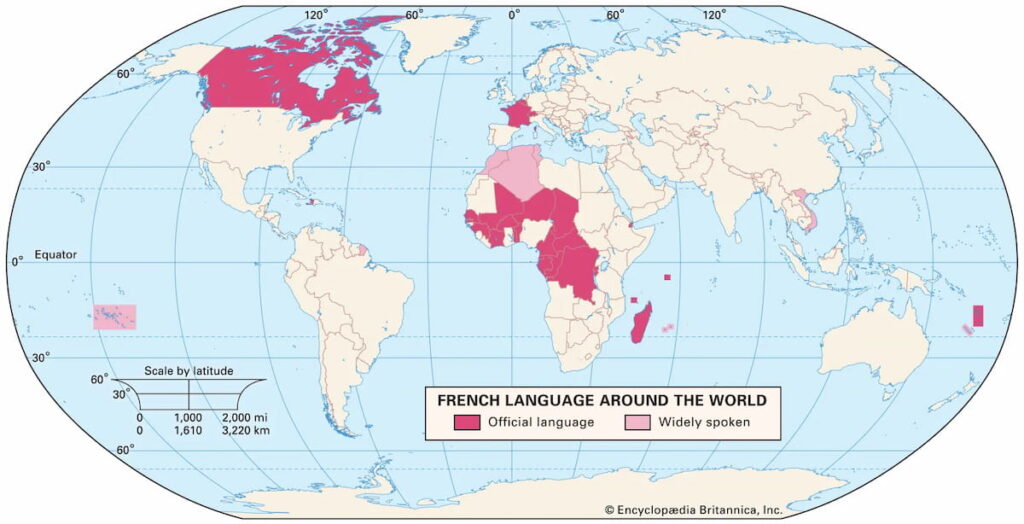
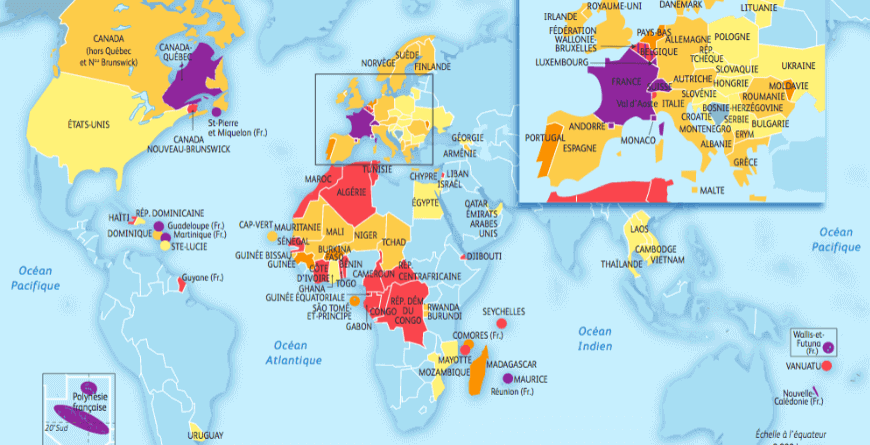
French is not just spoken in a few countries; it is the de facto language in 29 nations.
In contrast, the importance of well-known languages such as Italian, Korean, German, Japanese, and Portuguese is limited to a few nations.
This is one of the few languages with a global presence. English, Spanish, and Arabic are other languages that can be useful in many areas.
Below is a list of 29 nations where French is the official or national language. The language is noteworthy and holds political influence in many other places despite not being official.
E.g., Benin, Burkina Faso, Congo, Democratic Republic of Congo, Ivory Coast, France, Gabon, Guinea, Monaco, Niger, Senegal, Togo, Belgium, Burundi, Cameroon, Canada, Chad, Central African Republic, Comoros, Djibouti, Equatorial Guinea, Haiti, Luxembourg, Madagascar, Rwanda, Seychelles, Switzerland, and Vanuatu.
3. Importance of French in international business
Millions worldwide speak French, making it one of the most widely spoken languages.
This broad reach provides access to a diverse range of global markets. Proficiency in this language can open doors to business opportunities in various regions.
French is extensively spoken in the European Union and is crucial in international business. Speaking this language can be fruitful for companies operating within the EU.
French is widely spoken in many African countries, particularly in West and North Africa. These areas present growing business opportunities, and French can facilitate business transactions and negotiations.
According to OIF estimates, there will be approximately 715 million speakers in 2050. This accounts for approximately 8% of the world’s population.
Given the current numbers and trends, it is likely to increase. Studying French can help build personal connections and expand your skill prospects in the competitive global market.
4. Useful in various influential organizations
This is one of the few languages with wide-reaching impact and global status.
French is among the six official languages of the United Nations, along with Arabic, Russian, Spanish, English, and Chinese. French and English are the two working languages of the UN Secretariat and are used in daily professional exchanges.
French is a working language of many international bodies. E.g., NATO, the European Union, UNESCO, the African Union, the International Red Cross, the International Olympic Committee, international courts, and more.
It is the official language in the three cities that host the EU institutions: Strasbourg, Brussels, and Luxembourg.
All these give French-speaking countries a firm presence in global economic and diplomatic affairs.
There are tons of good reasons to learn French. Being part of so many influential institutions is undoubtedly encouraging.
5. A commonly taught and used Internet language
It is no secret that there are many French speakers around the globe.
Many people are committed to learning French, which is taught widely, unlike less common languages.
Over 50 million people study French as a foreign language, with varying levels of proficiency. The exact number is difficult to determine, but it is likely substantial and growing annually.
French is the second most taught language after English. French language learners can be found in nearly all countries across the five continents.
The language ranks seventh in internet usage. It’s a top language in education and comes second in practicality in scientific journals.
The significance of French as a global language is expected to rise. Adding French to your bucket list is a wise move. Its increasing reputation and usage make it a worthwhile pursuit.
II. For the love of Movies, Music, Dance, Culture, Arts & Literature
Most people are attracted to a country where a particular language is spoken for its artistic, cultural, and entertainment aspects.
French is not an exception. It’s one of the few languages studied for enjoyment and cultural exploration because it’s vibrant and resilient.

6. Watch incredible films and TV shows
Even if you don’t know a single word in French, you can enjoy the renowned TV series to learn French. Lupin, Emily in Paris, Family Business, Dix pour cent, M’entends-Tu?, L’Agence, Chef’s Table: France, The Hookup Plan, Drôle, and many more.
Also, you do not need to speak French to enjoy exciting football matches. In the Ligue, you can watch matches between Paris Saint-Germain, Monaco, Lille, Nice, etc. Maybe an exhilarating soccer match is unfolding in Algeria or Senegal.
You can enable this by switching the audio and subtitle settings to English or your preferred language.
Imagine desiring an outstanding TV show or French film for learners from France, Canada, Congo, Morocco, or Belgium.
What if no English subtitles or dubbing are available?
Listening to dubbed audio or reading subtitles limits our ability to fully appreciate a movie or show. This text lacks enthusiasm and is overly distracting. You always require help with translation.
French fluency opens up a world of possibilities for enjoying award-winning films and television shows from the comfort of your home, anytime.
You don’t need audio or subtitles. You can truly enjoy all those films and shows as they were initially intended.
Francophone regions are known for producing some of the best movies.
The good news is that your French skills will be valuable when seeing these films. You will also enhance your language talents in a natural background.
Le Fabuleux Destin d’Amélie, Les Intouchables, Persepolis, Detour, The Bastille Killer: A Woman’s Fight, Eyes Open, Duplicity, The Hummingbird Race, Paris Je T’Aime, À bout de souffle, Gemma Bovery and La Marche de l’Empereur.
And the list of excellent French cinemas goes on and on!
Getting help to understand everything that is said might be vital. For instance, French is often spoken quickly in films with abundant slang and idioms.
As you progress through your studies, you will increase your enjoyment and gain more profound knowledge of this exquisite language.
7. Listen to some original melodic music
It’s always a delight to listen to lovely music. Don’t you agree?
Many began learning French, surprisingly, because of the music and songs.
Would you like to know what Edith Piaf sings when she performs “La Vie en Rose” in Saving Private Ryan? One possibility is the lyrics to the chart-topping song by Adé, Davihor, Donamaria, George KA, and Leslie Medina.
There are many famous and classical French-speaking singers and musicians known worldwide.
Johnny Hallyday, Josephine Baker, Zaz, Vanessa Paradis, Cali, Soprano, Jean-Jacques Goldman, Julien Doré, Carla Bruni, Dalida, Claude François, Barbara, Serge Gainsbourg, Georges Brassens, Mélanie Pain, and many more.
Listen to French music to elevate your language skills.
Enhancing your pronunciation and hearing skills while expanding your vocabulary is delightful. Research has shown that singing can be beneficial when you learn a new language.
Listening to music significantly improves memory and attention span. It permits you to sharpen your focus and stay fully immersed.
It also enables you to enjoy and understand French culture and its regional variations.
8. Learn French to dance and have fun!
If you wish to study a new language and love dancing, combine the two by choosing French.
Learning a language is like knowing how to dance.
Patience, practice, and persistence are crucial to success. Everyone makes mistakes at some point. If you aim and work hard, you’ll overcome it and gain the recognition and win you’re qualified for!
French-speaking countries are home to many famous dances.
Experience the thrill of the French Cancan, valse musette, farandole, bourrée auvergnate, maraîchine, Java, Madison, and Zouk.
You can also explore African and other musical dances from various Francophone countries. All these can compel you to get on the melodic floor.
Does the movement of your leg show your interest in French dance?
When you learn French, you’ll learn more about it.

9. Access to a fantastic world-class literature
Francophone literature and philosophy have made unparalleled contributions to human history. One of France’s many benefits is access to a remarkable body of literature.
The French-speaking world has been blessed with the birth of many well-known writers, and their influence extends far beyond France’s borders.
French literature is highly regarded, widely read, and considered among the best in the world. Learning French to enjoy rich literature is a captivating and rewarding endeavor.
France’s literature has a long and illustrious history, with influential works from prominent writers. Suffragan works by Gustave Flaubert, Victor Hugo, Marcel Proust, and Albert Camus are available.
As your proficiency improves, start reading classic French literature.
Start with shorter works or abridged versions to make it more accessible. Progress to more complex texts as you become more comfortable with the language.
This comprises superb stories, tales, and wisdom, making studying this language more satisfying. As a result, you’ll learn French more quickly and have access to books unavailable in English.
Les Misérables, The Little Prince, The Strangers, The Hunchback of Notre Dame, Candide, The Count of Monte Cristo, The Three Musketeers, Père Goriot, and Germinal are among the most well-known French novels.
Engaging with works in their original languages is more meaningful than reading translations. If you have French proficiency, you can read the original text as written.
10. Appreciation of the Culture
One of the most notable perks of learning a new language is engrossing yourself in a different culture.
If you’re on the fence about French, consider the rich culture you’ll discover—it’s a lifelong experience!
Throughout history, it has had a profound impact on global culture. It has a widespread influence across Canada, Europe, and North, West, and Central Africa.
The cultural diversity and global use of French make Francophone nations highly desirable.
The diversity of this area is so extensive that it would take more than a lifetime to explore fully. Every region has traditions, history, lifestyles, French dialects, cuisines, and celebrations.
Learning French opens the door to exploring diverse cultural aspects, contrasts, and similarities. These can help you understand their culture and offer endless potential.
This language offers many cultural cues and helps you connect more deeply with others. You will gain a deep understanding of French customs, practices, and traditions.
Have you found something that motivates you?
If not, keep reading!
III. Common advantages of learning a language
Every language has its own benefits! Though they aren’t only intended for French learners, they’re just as worthwhile for them.
11. Boosts your brain and has multiple health benefits
Learning a second language can have various neurological and health benefits.
Studies conducted by Belgium’s University of Ghent suggest that learning a new language can slow the onset of Alzheimer’s and help to postpone the symptoms of dementia.
Also, the University of California’s analysis shows a correlation between language ability and pause duration.
Language learning can also help delay age-related cognitive decline. Research has shown that it can enhance executive functions, such as task switching and the inhibition of inappropriate responses.
The importance of French studies extends beyond that.
According to psychologists Michelle Martin-Rhee and Ellen Bialystok, people who speak two languages perform better than those who speak only one in problem-solving.
Based on reliable data, learning French advances cognitive performance. The efficacy is infinite, from better memory to enhanced multitasking and decision-making.
Your health and brain can benefit from learning French.
12. Improve your own and learn other languages.
Learning a new language can improve your understanding of your native language. This is indeed fascinating.
Studies have indicated a correlation between the languages we already know and the ones we are currently learning. Understanding how our brain functions can enhance our language skills.
As you delve deeper into language learning, everything makes sense and becomes more logical. One needs to comprehend the linguistic principles and rules of the foreign language.
For English speakers learning French, mastering sentence structure is crucial.
Writing complex and convincing sentences is easier to achieve in your native language or the language you are proficient in. This is because you pay close attention to syntax and regulations.
Learning a new language can help develop your fluency and sharpen your skills and knowledge. The more languages you become proficient in, the easier it is to learn a new one.
13. Connect, build friendships and relationships
Many individuals learn a new language to enhance their communication with loved ones. This can be for personal, professional, or social reasons. The same holds for the French.
French can help you communicate with family members or friends who speak the language but don’t share your native tongue.
If you work in a specific field or run a business, you can often interact or converse with French-speaking people.
Regardless of your reasons, it can effectively convey your thoughts and feelings to individuals. It permits chances to meet fluent speakers throughout your lifetime, even if you don’t know any natives.
Thankfully, French is one of the most widely spoken languages.
It offers ample opportunities to practice and improve your skills. This can be especially helpful for making references, learning new things, and socializing at work or traveling.
The more time and effort you devote to mastering the language, the more positive the response will probably be. You can quickly build meaningful relationships that last for years.
14. Discover a fresh outlook on life
A famous Czech proverb says, “You live a new life for every new language you speak.”
Speaking many languages helps us to live many lives. On the other hand, knowing only one language means only living once. Many studies have shown that we exhibit distinct personalities when speaking a foreign language.
The language you choose to speak can influence your personality. Language learning can broaden your personal horizons and unlock new avenues of fulfillment.
French, for example, is a language that can grant you a unique persona. Achieving fluency can give you a sense of mastery that lasts a lifetime.
IV. Benefits of the French language
Some perks are unique to specific languages and are not found in others. Let’s examine some distinct advantages of the French language.

15. French is not a difficult language to learn
According to FSI studies, French falls into category I and is close to English. As a result, this is easier for English speakers who are willing to try.
Like French, Portuguese, Italian, and Spanish, English has many words that come from Latin.
This suggests you can find thousands of cognates, like those in English. The terms sound different but mean the same.
Air, campus, date, export, film fruits, guide, horizontal, instinct, jungle, karma, long, machine, nature, opinion, pause, quota, radio, secret, taxi, unique, vacant, yoga, zoo.
The list of perfect English-French cognates is unlimited!
You don’t have to learn a totally new alphabet, either. Asian languages such as Thai, Korean, Vietnamese, and Cantonese place greater emphasis on tones than French.
Unlike Spanish, French is not that phonetic. The accents and pronunciation are complex and often tricky.
French can be challenging for English speakers in some areas, such as pronunciation and verb conjugation. It also has several silent letters and nasal vowels, which can be difficult for English speakers to master.
Typically, French is perceived as a complicated European language, but it is actually more straightforward than you might think. You memorize less complex spelling rules and focus more on pronunciation.
Despite fewer articulation rules, the grammar is vast, and the number of tenses is challenging. Yet passion and consistent practice will pave the way to your success.
If you want to master a moderate language, i.e., neither simple nor easy, French is the way to go. This language is not that demanding.
16. Plenty of resources for learning French
Do you know the difficulty of learning a less familiar language, such as Finnish, Tatar, Somali, or Bulgarian?
If you strive to learn a less-taught language, your choices for locating books, audio, teachers, or native speakers are restricted. Finding nearby courses is challenging, and online options are limited.
It can quickly become frustrating when you lack resources. This makes it challenging to make meaningful progress.
Learning a widely spoken language such as French can help you achieve fluency. If you are getting ready for the DELF exam, you will have superior access to many study materials.
You can find text-based content, lessons, exercises, audio, and videos to study French anywhere you live. For instance, French learning apps, educators, bookstores, and language schools.
French is among the most widely taught languages. Hence, you will have access to an enormous range of resources. Focus on choosing the right path to achieve your goal rather than on how or where to seek help.
17. Gateway to other Romance languages.
It is easier to learn a second language if it is part of the same language family as the one you already know.
Romance languages such as Spanish, Portuguese, Italian, Romanian, and French came from Vulgar Latin. Therefore, they share many similarities, such as verbs, grammar, vocabulary, and sentence structure.
Not all Romance tongues are linguistically close despite the closeness in pronunciation.
For instance, the difference between French and Spanish sounds is substantial. You will make an advance once you have a good grasp of the language.
Learning French can serve as a starting point for learning other Romance languages.
It also helps English, Dutch, German, Scandinavian, and other European languages. This is because most share Indo-European roots and similar features.
18. French is a beautiful language
French is a beautiful language, exuding elegance and sophistication. Its melodious cadence and poetic expressions create a harmonious symphony of words.
The language’s rich history and cultural essence add depth to its beauty, encapsulating centuries of literature, philosophy, and art.
French offers an intricate dance of sounds, where every syllable carries a nuanced meaning. The eloquence amplifies its allure, captivating listeners with a sense of refinement.
This language evokes a sense of romance and charm, whether spoken in passionate discourse or whispered. Its beauty lies in words and the graceful expression of dance that unfolds with each utterance.
IV. Career opportunities and job options
Most people choose to learn French for the career opportunities it offers.
With so many professions and new career options, it makes sense. Let’s explore this further!

19. Job opportunities requiring French
Learning this language can open up exceptional job prospects in French that may not be possible otherwise.
Language jobs pay well, which can raise your earnings. You may also have opportunities to travel and earn money to explore the world.
In today’s globalized world, companies prefer bilingual employees.
Fluency in French increases your chances of being selected as a suitable candidate for various companies. It enhances job opportunities and leads to better work and higher salaries.
The need for French speakers in outsourcing, KPO, and BPO is growing. New openings are available in media, infrastructure, publishing, finance, technology, tourism, IT, and other fields.
French is one of the most widely used online languages in the digital media sector. Many French-language websites, social media platforms, and online news outlets exist.
It can give your C.V. a unique edge. Standing out from the competition is crucial when applying for the same position as other candidates.
Working as a freelancer is another ideal option. You could be a writer, linguist, tour guide, translator, interpreter, proofreader, teacher, or video maker.
Experience and strong references are essential to secure employment and a stable income.
20. Career change to French
Learning French is promising not just for your current position but also for future job alternatives. The skills allow you to explore different career pathways.
In a competitive job market, additional skills, such as French language proficiency, can make a significant difference when transitioning to a new career. It is an invaluable, in-demand asset for expanding your career horizons.
It broadens your job options and demonstrates your commitment to professional and personal growth. Knowledge of French is valuable and may lead to higher pay.
French matters if you’re looking for new work or trying to advance in your current profession. Also, bilinguals can help you stand out when vying for promotions and salary hikes.
21. You can do your job better
While not all jobs require French skills, the language is a practical asset for some.
For instance, suppose you work in the hospitality industry. Then, there’s a good possibility you may meet some French-speaking tourists, depending on your location.
Communicating with them allows you to resolve their issues quickly and helps them feel at ease. Knowing you did a better job of helping them will give you greater fulfillment.
Additional benefits include promotions, higher wages, and other rewards and compensation. And, of course, gratitude and liking!
VI. Travel, study, and job in Francophone countries
French can help if you plan to move to French-speaking regions. It covers pursuing higher education, working, traveling, visiting family, and settling in as an immigrant.

22. It is useful for travelers
French is fantastic for traveling. This is because it is spoken in over 25 countries with large populations. You will still find many speakers, even in places where it isn’t the prevailing language.
You can travel to French-speaking countries, such as France, Canada, Belgium, Luxembourg, Switzerland, Madagascar, Senegal, and Rwanda.
You don’t need to know any French to do this. Still, the experience wouldn’t be that splendid.
You’ll feel more comfortable and earn their gratitude by speaking up. It promotes genuine interaction and connection. Doing so can enhance your travel skills, help you meet new people, and enrich your life.
The beautiful beaches of French Polynesia, the mountains of Switzerland, and the incredible wildlife of Senegal. Quebec’s majestic natural beauty and the delicious cuisine of France are solid reasons to learn French.
Your proficiency in French can take you off the beaten path and expose you to a rich culture. Fluency is not compulsory. A beginner’s level can still affect and augment your trip experience.
French helps you travel confidently, adapt to local customs, and save money. You can interact with everybody, guide like a pro, and get better treatment.
These reasons are solid if you travel to a place where it is the dominant language.
23. Immigrate to French-speaking nations
Living and working abroad can have a powerful impact on one’s life. It exposes you to new perspectives on people, customs, places, festivals, cultures, and yourself.
People travel for various motives. But speaking the local language is crucial if you plan to migrate permanently.
Not only does it increase your chances of obtaining a work permit or visa, but it also makes for a more relaxed stay and employment.
More than 30 nations worldwide have French as their primary or national language. This is advantageous for those who want to move overseas.
Also, once you learn French, you can improve your personal and career prospects in Canada if you intend to live there. If you get a B2 in TEF or TCF, you can earn bonus points to increase your chances of acceptance. You can look for TEF French Canada courses or TCF Canada courses, either online or in person.
No matter where you live in a Francophone region, French will be critical to your everyday life. The primary reason is that most locals do not speak English.
24. Study in France, Canada, or other Francophone nations!
How about studying in France, Canada, or one of the best universities in other French-speaking countries?
Learning French can be rewarding in those regions. There are also many excellent universities and academic institutions to choose from.
Do you wish to reach a high level of French exams like C1 and C2 or even a master’s? Here, aiming for higher levels is the best way.
You’ll get the motivation to engage and improve your French skills.
Studying abroad is an unforgettable venture. It offers many opportunities for adventure, joy, and discovery.
After completing your education, searching for work may be something you think about. That’s where French will make a real difference and boost your resume.
It can help you step beyond your comfort zone and shape your personal life and career.
Final Thoughts: Is learning French worth it?

Are any of these 24 reasons inspiring enough for you to undertake the journey of learning French? It can be a good starting point, even if you have only one motivation.
Then what are you waiting for? Begin your fantastic trip to discover French by taking the first step.
Knowing this language brings extraordinary value to both your personal and professional life.
If you want to start, check out LanguageNext’s range of French courses in Noida, Sector 18. There is something for everyone. You can also choose from online French classes and study anywhere and anytime at a reasonable price.
Have I persuaded you enough to consider learning French?
Do you have any questions or views about the French language that you would want to share?
Please feel free to share your thoughts in the comments section below! I look forward to hearing from you!